
The choice of an advertising poster format is not just a matter of centimeters. Behind each dimension lie technical constraints, varying reading conditions from a distance, and budget considerations that advertisers often underestimate. Understanding common advertising poster formats requires cross-referencing ISO 216 standards with real-world realities: type of support, installation location, and reading distance.
Bleed and A0+ formats: the dimensions hidden behind the visible format
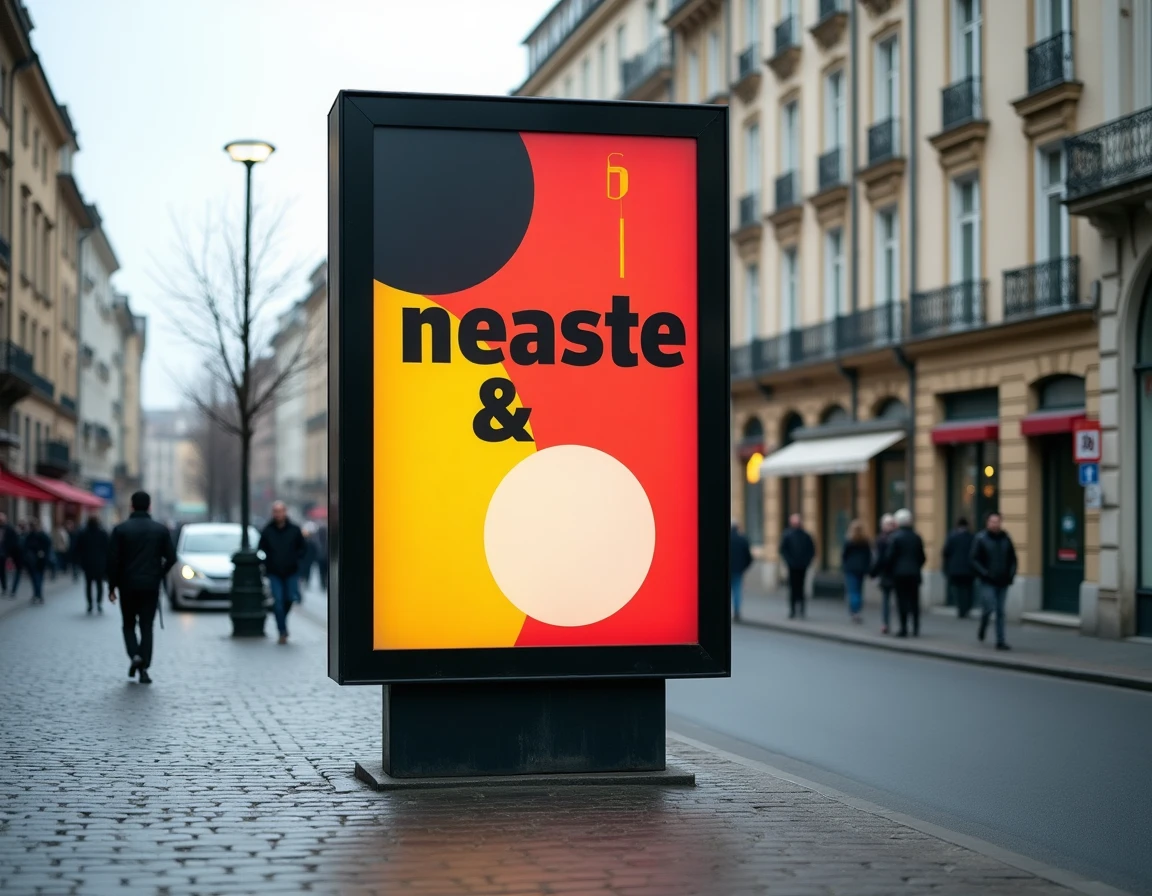
Most guides present poster formats as fixed rectangles, aligned with the standardized A series. The reality in printing is more nuanced. For large formats (A1, A0 and beyond), professionals commonly work with A0+ formats, larger than 84.1 x 118.9 cm. This additional surface area is not decorative: it absorbs bleed, technical margins, and cutting marks essential for a clean finish once the poster is trimmed.
Specifically, a file intended for a visible A0 poster requires a slightly oversized source document. Without this margin, any slight misalignment during trimming reveals an unsightly white border on the edge of the poster. This detail, rarely specified in consumer guides, explains why some quotes mention dimensions that do not correspond to any standard ISO format.
This technical point has a direct consequence on the budget: the paper used exceeds the useful surface area, and the cost per square meter includes this unavoidable loss. A comprehensive guide on common advertising poster formats helps better anticipate these discrepancies between visible dimensions and actual production dimensions. Requesting a “perfectly A0” format from a printer ignores this constraint, risking a degraded output.
Print resolution by format: why 300 dpi is not always the right answer

The default recommendation to work at 300 dpi is widespread. For an A4 or A3 poster viewed up close (window display, counter, reception area), this resolution remains relevant. However, beyond A2 format, the logic changes radically.
An A0 poster installed on a storefront is read from several meters away. At this distance, the human eye can no longer distinguish fine details. Printers specializing in large formats commonly accept files at 150 dpi, sometimes less for very large banners. Demanding 300 dpi for an A0 or 4×3 unnecessarily increases the file size (several gigabytes), slows down the production chain, and provides no perceptible visual gain.
The real question to consider before choosing a resolution boils down to two parameters:
- The minimum reading distance intended for the poster (less than one meter, between one and three meters, more than five meters)
- The type of printing support, as a satin-coated paper reproduces fine details better than a micro-perforated PVC banner or adhesive vinyl
- The weight of the final file, which affects processing times at the printer and potential prepress costs
For an A3 format indoors, maintaining 300 dpi is reasonable. For a 4×3 roadside, 150 dpi is more than sufficient without loss of perceived quality.
LED poster screens: the poster format that blurs traditional references
Since 2024, so-called “poster” LED screens have been gaining ground in retail windows, trade shows, and reception halls. These thin vertical totems, often in a 9:16 ratio, adopt the visual codes of paper posters while adding movement and scheduled programming.
The common dimensions of these LED poster screens are around 640 x 1920 mm, a size close to the vertical kakemono used in events. The design logic shifts from centimeters to image ratio: where a graphic designer thinks in A2 or A1 for paper, they must reason in 9:16 for a screen, with very different readability constraints (brightness, contrast, time spent in front of the screen).
This shift from paper to digital does not mean that traditional posters are disappearing. However, it changes how advertisers weigh their options between media. A retailer hesitating between an A1 poster in the window and a vertical LED screen is not just comparing prices: they are comparing lifespans, update capabilities, and environmental impacts that are not comparable.
Poster formats and installation context: the often-overlooked criterion
The ideal format for a poster depends less on a theoretical standard than on where it will be installed. An A3 placed on a free advertising panel in the city center will be drowned among other posters. The same A3 placed alone on an easel at the entrance of a restaurant will capture all the attention.
Some concrete benchmarks deserve to be established:
- Indoors (counter, waiting room, hallway), A4 and A3 formats remain the most used because they fit into standard frames and poster holders available everywhere
- In windows, A2 or A1 provide sufficient surface area to be readable from the sidewalk, provided the message remains limited to a few words
- In urban advertising (bus shelters, Morris columns, 4×3 panels), formats are imposed by urban furniture and advertising agencies, leaving little room for maneuver on dimensions
- At trade shows or events, vertical formats like kakemono or roll-up (often around 85 x 200 cm) dominate because they take up little floor space while offering great height for reading
The most common format in advertising display remains 120 x 176 cm (bus shelter format), as it corresponds to the most widespread urban furniture in France. National campaigns use it massively for its visibility at eye level for pedestrians and stopped motorists.
The paper poster retains an advantage that digital cannot easily replace: it works without electrical power, without software maintenance, and with a unit cost that decreases significantly as the print run increases. For a local campaign with a tight budget, a print run of a few dozen A2 posters often remains the best visibility-cost ratio. The choice of format is best dictated by the actual display context rather than a theoretical grid of dimensions.