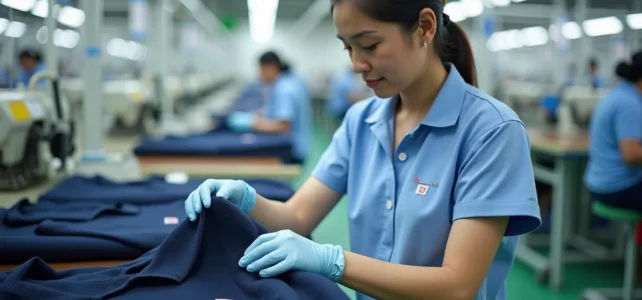
When returning a Tommy Hilfiger polo purchased in a store in Nantes or on the official website, the label rarely mentions the same country twice in a row. One knit model may indicate Bangladesh, the next Turkey, a third Vietnam. This dispersion is not random: it reflects the industrial strategy of the PVH group, which has owned the brand since 2010, with its operational headquarters located in Amsterdam.
Tommy Hilfiger Supply Chain: Who Makes What
Tommy Hilfiger does not own any factories. All production is entrusted to first-tier (final assembly) and second-tier (dyeing, weaving, knitting) subcontractors. PVH’s 2024 sustainability report includes an appendix listing these suppliers, which allows for a concrete trace of where Tommy Hilfiger clothing is made according to product categories.
The majority of the volumes destined for Europe and North America come from workshops located in Bangladesh, Vietnam, China, India, and Turkey. Recently, Jordan and Egypt have also been added to these five historical countries, focusing on denim and knit lines.
Specifically, a Tommy Hilfiger jean sold in France is likely to come from Bangladesh or Egypt. A pique cotton polo is more often made in Vietnam or India. Technical pieces (light jackets, blousons) still largely come from China, although this share is decreasing.
Tommy Hilfiger Production in China: A Strategic Retreat
The weight of China in PVH’s supply volumes has clearly decreased in recent years. The group’s investor communications for 2023-2024 confirm this: PVH is voluntarily reducing its dependence on Chinese production. Three factors converge.
- Labor costs in China have significantly increased compared to Bangladesh or Vietnam, making some basic product lines less competitive.
- Sino-American trade tensions (tariffs, export restrictions) create uncertainty that the group prefers to circumvent by diversifying its sources.
- The desire to reduce the risks of supply chain disruption, highlighted during the Covid period, pushes PVH towards a broader geographical distribution.
Vietnam and Indonesia are capturing an increasing share of the volumes leaving China. There is also a shift towards Bangladesh for labor-intensive pieces. China retains a role in higher value-added products or those requiring specific technical finishes.
Nearshoring in Turkey, Portugal, and Morocco for the European Market
For collections sold in Europe, PVH is developing a nearshoring strategy: bringing manufacturing closer to the final market. Turkey plays a central role in this setup, particularly for denim, shirts, and knit pieces. Geographical proximity reduces delivery times and maritime transport costs, a direct advantage when restocking a Parisian store in the middle of the season.
Portugal and Morocco are also involved, mainly on shorter series or pieces requiring production responsiveness that Asian factories cannot offer on tight deadlines. Returns vary on the exact scale of these nearshore volumes, but the trend is confirmed by PVH in its presentations to investors.
What Nearshoring Changes for the Buyer
A garment made in Turkey or Portugal is not automatically of better quality than a product sewn in Vietnam. The difference lies mainly in flexibility: these nearby factories allow Tommy Hilfiger to launch seasonal capsules with limited volumes, test colors or cuts without committing to massive production in Asia.
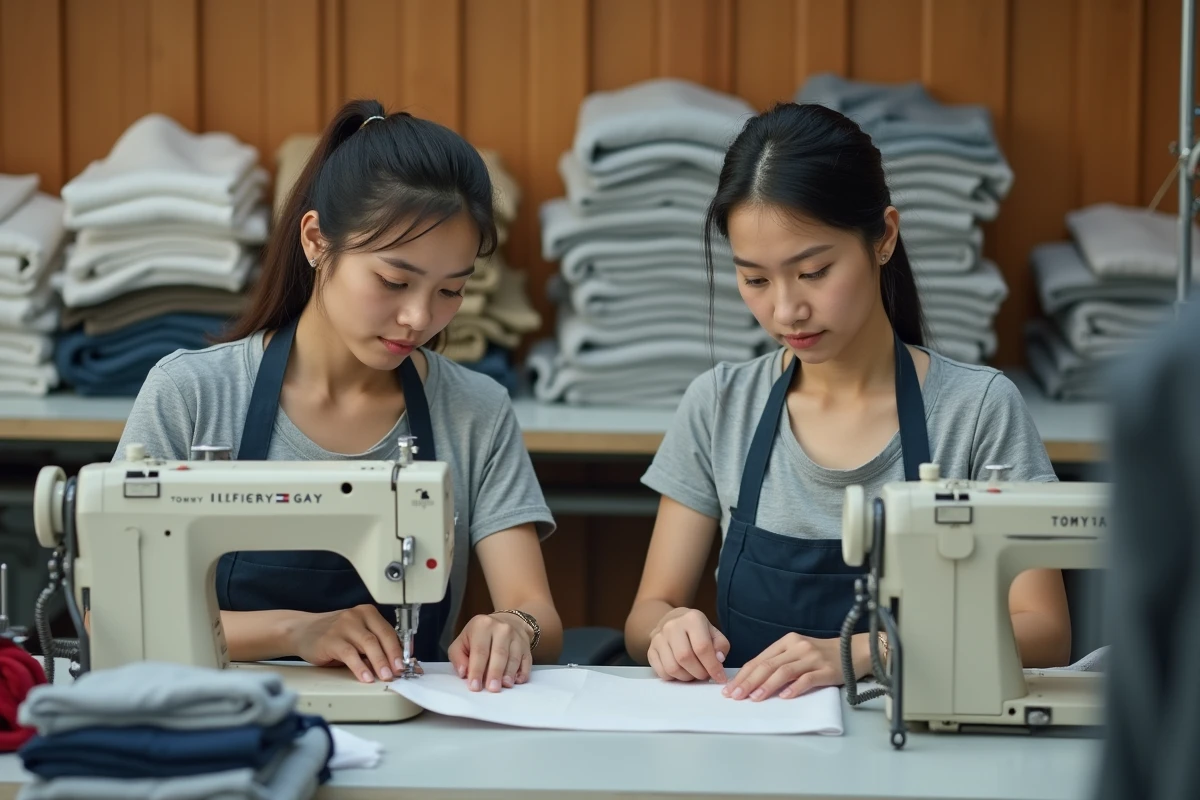
Quality Control and Supplier Audits for Tommy Hilfiger
Outsourcing in a dozen countries does not mean relinquishing control. PVH implements an audit program for its first and second-tier suppliers, documented in its responsibility report. The audits focus on working conditions, environmental standards, and compliance of finished products.
The list of suppliers is published annually, which remains a minority practice in the textile industry. It is thus possible to verify in which country and sometimes in which city a type of product is assembled. This transparency has its limits: third-tier suppliers (spinning, raw material production) are not always referenced with the same level of detail.
Reading a Tommy Hilfiger Garment Label
The sewn label indicates the country of final assembly, not where the fabric was woven or dyed. A “Made in Vietnam” polo may very well use Indian cotton, dyed in Bangladesh, then assembled in Ho Chi Minh City. The country indicated on the label only covers one stage of manufacturing.
For those wishing to trace the actual origin of a garment, consulting the PVH supplier list remains the most reliable means. It is accessible in the appendices of the group’s annual responsibility report.
Tommy Hilfiger and Sustainable Fashion: Concrete Production Commitments
PVH has set targets for reducing emissions and water consumption for its brands, including Tommy Hilfiger. These targets largely depend on the choice of suppliers and production areas. Nearshore factories in Turkey or Portugal emit less CO₂ related to transport than those in Southeast Asia, which factors into the overall calculation.
The brand is also developing lines using organic cotton and recycled materials. These materials are sourced separately, often through certified supply chains, and then sent to subcontractors for manufacturing. The “Tommy Hilfiger” label on a garment does not guarantee sustainable production on its own, but the publication of supplier lists allows for a start of traceability that many competing brands at the same price point do not offer.
The production of Tommy Hilfiger clothing follows a global distribution logic dictated by costs, market proximity, and logistical risk management. Today, Bangladesh, Vietnam, and Turkey concentrate the majority of volumes, while China is gradually retreating. For the consumer, the only reliable certainty remains the sewn label, supplemented by the data published annually by PVH.